
Back to Hub
EN HI
Investor Awareness

MRF Stock: The Real 15-Year XIRR (Backtested Data, Not WhatsApp Math)

Backtested data, not WhatsApp math. ₹5,000/month SIP in MRF for 15 years — real XIRR, real numbers. Not a crorepati, but 4x your money.

Kuldeep Singh By Kuldeep Singh July 3, 2026 6 min read
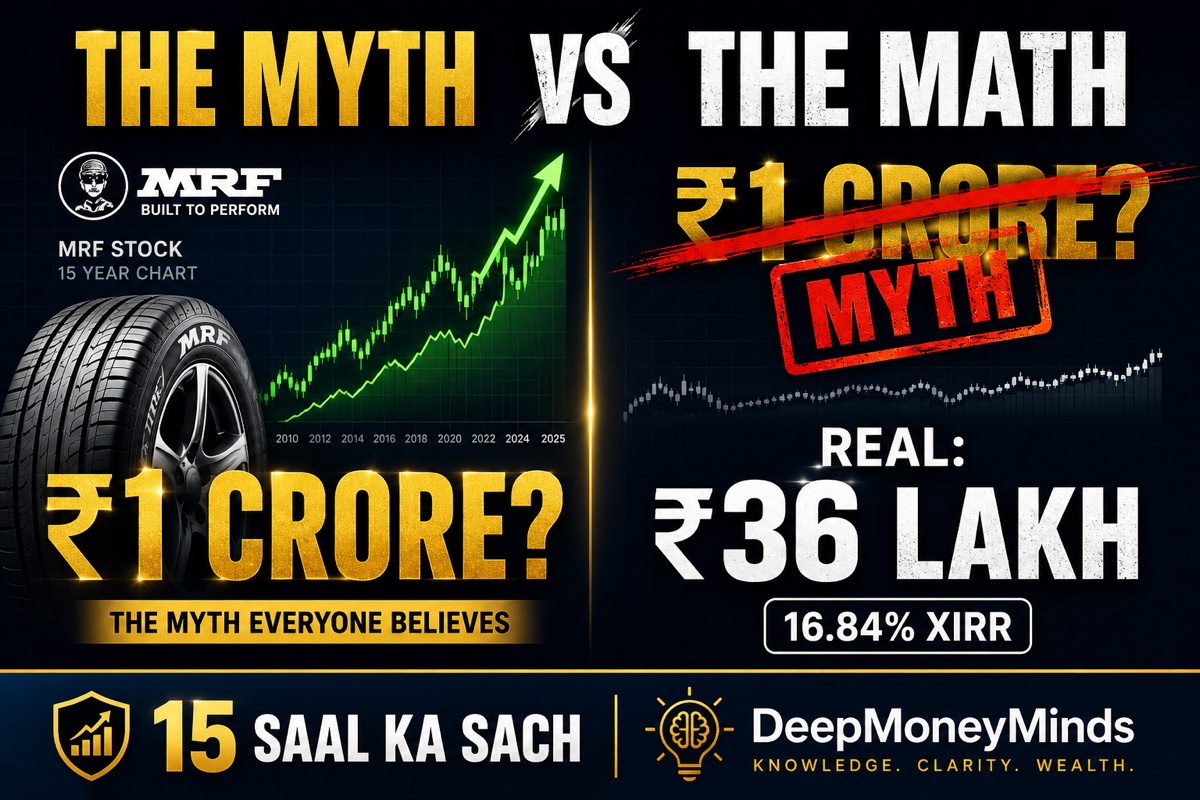
MRF tyre with stock chart showing 15 year SIP return analysis
"

Bhai, MRF 15 years ago le liya hota toh aaj karodpati hote.

Family WhatsApp group. Office chai break. Saturday evening with relatives. India's most expensive stock sounds like guaranteed money. So I stopped guessing and ran the actual backtest.

MRF Ltd (formerly Madras Rubber Factory Ltd) · NSE: MRF · BSE: 500290 · India's highest-priced listed stock.

₹9L
Total invested · ₹5,000/mo
₹36L
Final value after 15 years
16.84%
Real XIRR · Yahoo Finance data

Not a crorepati — but 4× your money. Here's the full story.

The confusion

What is XIRR and why is absolute return misleading for MRF?

XIRR is the correct metric for measuring SIP returns — it accounts for the exact date and amount of every monthly investment. Absolute return (the "900% in 15 years" number) hides how long wealth creation took, making gains look far more dramatic than they are on a per-year basis.

Every "MRF made me rich" story uses absolute return language. "900% in 15 years!" Big number, impressive headline — but it hides one critical detail: how long it took.

What gets said

"900% in 15 years!"

Total gain over the whole period — used for WhatsApp forwards and making people feel bad about not buying earlier.

What's true

"~16.84% per year"

Annualised, accounting for every SIP date and purchase price. Boring — but this is the real truth. Always ask for XIRR.

Quick example — a stock goes 10× in 15 years, so absolute return is 900%. Sounds insane. But XIRR is just ~16.6% per year. Solid, not "get rich overnight" territory.

Whenever someone shows only absolute return — a fund, a stock, or an insurance policy — the number is being inflated. Always ask for XIRR.

The evidence

What does a ₹5,000/month SIP in MRF actually return over 15 years?

A ₹5,000/month SIP in MRF Ltd. (NSE: MRF) from June 2010 to June 2025 — ₹9 lakh invested across 180 monthly installments — grew to approximately ₹36 lakh at a 16.84% XIRR. Data: Yahoo Finance adjusted closing prices for MRF.NS, backtested via Newton-Raphson XIRR on actual monthly purchase prices.

I ran MRF on the SIP Backtester with real Yahoo Finance historical price data. Here's what came out:

Stock

MRF

Monthly SIP

₹5,000

Period

15 yrs

Real XIRR

16.84%

Fractional share simulation used — the standard approach for SIP backtesting. Source: adjusted closing prices for MRF.NS and NIFTYBEES.NS, June 2010 – June 2025, XIRR via Newton-Raphson on actual monthly purchase prices.

Honestly? 16.84% XIRR is genuinely impressive — Nifty 50's long-term average over the same period stayed below it. MRF consistently created wealth, no doubt about that.

Common question — "MRF is ₹1.5 lakh per share, how does a ₹5,000 SIP work?" The backtester uses fractional share simulation, the way US and Japan markets work. In India today you'd need the full share price upfront, or a mutual fund that holds MRF.

The math

Does a ₹5,000/month MRF SIP make you a crorepati in 15 years?

No. At 16.84% XIRR, a ₹5,000/month SIP in MRF grows ₹9 lakh to roughly ₹36 lakh over 15 years — excellent wealth creation (4× your money), but well short of ₹1 crore. To reach ₹1 crore at that same 16.84% rate, the monthly SIP needs to be ~₹13,000–14,000.

Let's do the actual math: ₹5,000/month, 15 years, 16.84% XIRR.

Total invested (₹5,000 × 180 months) ₹9,00,000
Final value @ 16.84% XIRR ~₹35–36 L
Net profit ~₹26–27 L
Crorepati? ₹35L ≠ ₹1 Cr

₹9 lakh turning into ₹36 lakh is excellent — your money 4×'d. But crorepati? No.

To actually reach ₹1 crore at 16.84% in 15 years, you'd need:

SIP route

~₹13,000–14,000/month for 15 full years, without stopping once during crashes.

Lumpsum route

~₹9.7 lakh invested all at once in 2010–11, into a single stock.

The visual

Growth vs amount invested

₹5,000/month SIP · MRF 16.84% vs NiftyBees ~13% vs amount invested

The trade-off

MRF vs Nifty 50 vs Gold vs FD: which gave the best 15-year SIP return?

On a ₹5,000/month SIP from June 2010 to June 2025, MRF delivered the highest XIRR at 16.84%, beating Nifty 50 ETF (~13%), Gold (~10–11%), and bank FDs (~6–7%) — but with single-stock concentration risk that none of the others carry.

1

MRF Ltd

NSE: MRF · ₹9L → ~₹36L · Single stock risk

16.84%

XIRR

2

Nifty 50 ETF

NiftyBees · ₹9L → ~₹28L · 50 stocks

~13%

XIRR

3

Gold (Sovereign / ETF)

MCX Gold · ₹9L → ~₹22L · Low equity risk

~11%

XIRR

4

Bank FD

SBI / HDFC · ₹9L → ~₹15L · Guaranteed

~7%

XIRR

Source: Yahoo Finance (MRF.NS, NIFTYBEES.NS) · June 2010–June 2025. Gold XIRR estimated from MCX Gold spot prices. FD rate averaged from SBI/HDFC published 5-year deposit rates over the period.

Same ₹9 lakh. Same 15 years. Now zoom into the top two:

MRF.NS · higher return

16.84%

XIRR · ₹9L grew to ~₹36L

RiskSingle stock
SIP in IndiaNot direct

NiftyBees · lower risk

~13%

XIRR · ₹9L grew to ~₹28L

Risk50 stocks
SIP in IndiaYes, easy

MRF gave ₹8 lakh more on the same investment — with single-stock risk, and no direct fractional SIP available in India. Worth it? That's your call.

Behind the story

Why do MRF "made me a crorepati" stories mislead Indian investors?

These stories mislead because they combine three separate distortions: they use absolute return (900%) instead of XIRR (16.84%), they never state how much was actually invested, and they exploit survivorship bias — only MRF's winners get forwarded, never the thousands of Indian stocks that went to zero over the same period.

01

The investment amount is always hidden

A small SIP at any rate — even 20% XIRR — can't create a crore by itself. "16.84%" and "crorepati" are two different claims, mixed together.

02

Hindsight bias does all the work

Picking MRF 15 years ago looks obvious today. Thousands of other stocks went to zero — nobody forwards that message.

03

Staying invested through crashes takes real discipline

MRF would have crashed 40–50% at least twice in 15 years. Most people stop exactly when they should buy more.

Takeaways

What does MRF's 15-year backtest teach Indian stock investors?

Focus on XIRR, not headlines

"10× in 15 years" and "16.6% per year" are the same thing said differently. One is marketing, one is math.

Amount beats rate

16.84% on ₹5,000/mo = ₹36L. Same rate on ₹14,000/mo = ₹1 Cr. Amount and consistency are what you control.

Backtest every claim

Feelings vs data — data wins. That's exactly why the SIP Backtester exists.

Past performance guarantees nothing

MRF delivered for 15 years. The next 15 are a blank page. Single-stock risk stays higher than a diversified fund.


Our verdict

MRF delivered. But no stock turns ₹5,000/month into a crore — and that's okay.

4×-ing your money in 15 years is real wealth creation. The "karodpati" narrative is maths-washing. If you want ₹1 crore: invest more, stay consistent, and stop hunting for the next MRF.

Questions

Frequently asked

What is XIRR and why does it matter more than absolute return? +

XIRR accounts for the exact date and amount of every investment. Absolute return tells you the total gain but hides how long it took — 900% over 5 years and over 15 years look identical in absolute terms but are radically different returns.

Can I actually do a SIP in MRF? The share is ₹1.5 lakh. +

Not directly — Indian exchanges don't allow fractional share purchases yet. You'd save up for a full share periodically, or invest via a mutual fund that holds MRF as part of its portfolio.

Is 16.84% XIRR actually good versus Nifty 50? +

Yes. Nifty 50's long-term SIP XIRR over the same June 2010–June 2025 period was roughly 12–14%. MRF outperformed the broad index by 3–5 percentage points annually — but with full single-stock concentration risk.

How much monthly SIP to reach ₹1 crore in 15 years? +

At 16.84% XIRR, roughly ₹13,000–14,000/month. At a more conservative 12%, around ₹20,000/month. Use the SIP Calculator for exact numbers based on your target and timeline.

Where does the historical price data come from? +

Directly from Yahoo Finance, refreshed on every run — no stale cache. XIRR uses the Newton-Raphson method on the actual purchase price at each SIP date, not a simplified formula.

Why is MRF share price so high? +

MRF's share price is high because the company has never split its shares since listing — so decades of compounding price growth is concentrated in a single share. A high share price does not mean the stock is expensive; what matters is valuation (P/E ratio), not the rupee price of one share. MRF's P/E has historically been in line with other auto-ancillary companies.

Why has MRF never split its shares? +

MRF management has not publicly committed to a split, and the company has no regulatory obligation to do so. Some analysts believe the high price acts as a natural filter, reducing speculative trading. Berkshire Hathaway (Class A) follows the same philosophy — its shares trade above $600,000 each for the same reason. A split changes nothing about the underlying business or your percentage ownership.

Can I buy just 1 share of MRF? +

Yes — MRF's market lot size is 1 share, so you can buy a single share through any SEBI-registered broker (Zerodha, Groww, Angel One, etc.). At ~₹1.3 lakh per share, it requires that much capital upfront. Indian exchanges do not currently allow fractional share purchases, so there is no way to invest a smaller amount directly in MRF stock. The alternative is a mutual fund that holds MRF in its portfolio.

Why is MRF not in the Nifty 50? +

Nifty 50 selection is based on free-float market capitalisation, not share price. MRF's total market cap is large but its free-float (shares available for public trading) is relatively low because the promoter family holds a significant percentage. NSE's index committee also considers liquidity — the high per-share price means fewer shares trade hands daily compared to lower-priced large-caps, which reduces its liquidity score for index eligibility.

Is MRF share overvalued? +

Valuation cannot be judged by share price alone. A stock at ₹1.3 lakh can be cheaper than one at ₹100 if the earnings justify it. MRF's P/E ratio and return on equity are the right metrics to check against peers like Apollo Tyres and CEAT. Historically, MRF has traded at a modest premium to peers due to its brand strength and debt-free balance sheet — but whether it is overvalued at any given moment requires looking at current earnings, not past returns. This blog covers historical XIRR, not a buy/sell recommendation.

Kuldeep Singh
Written by

Kuldeep Singh

I believe that knowledge is the ultimate currency. Through Deep Money Minds, I bridge the gap between complex financial concepts and everyday practical technology to help you succeed.