
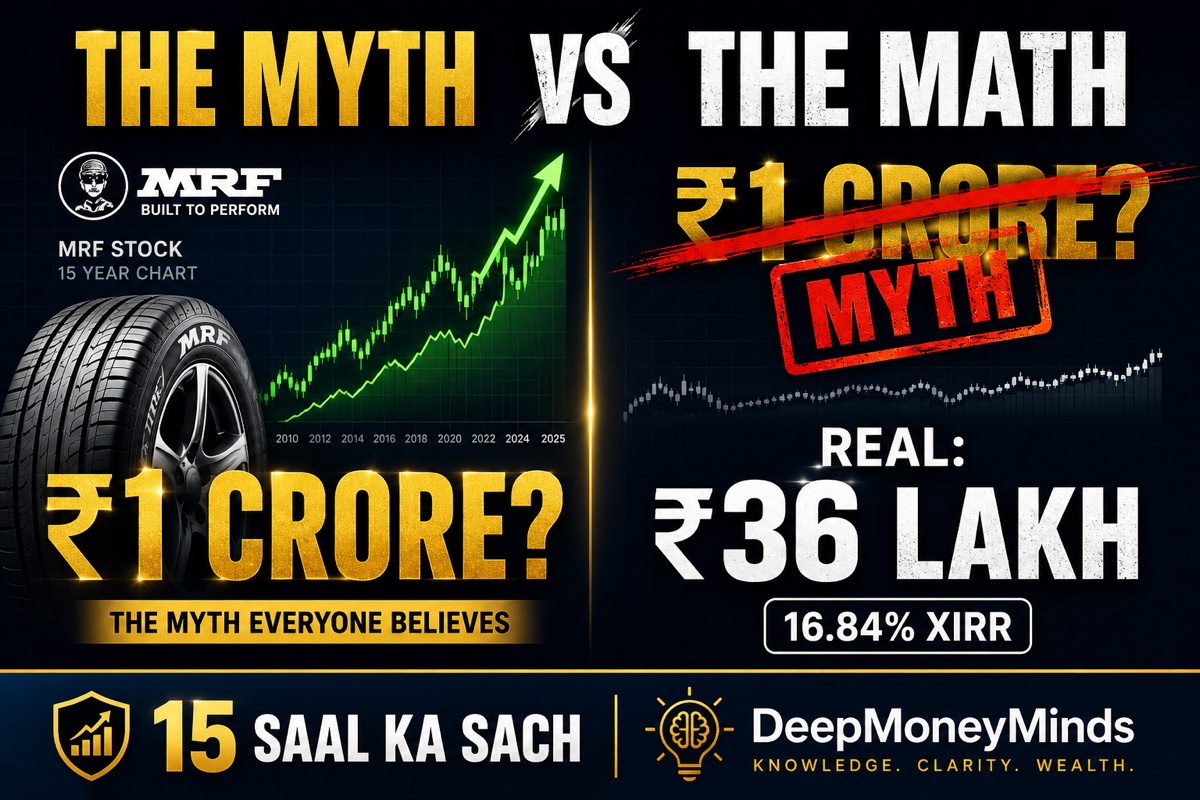
Bhai, MRF 15 years ago le liya hota toh aaj karodpati hote.
Family WhatsApp group. Office chai break. Saturday evening with relatives. India's most expensive stock sounds like guaranteed money. So I stopped guessing and ran the actual backtest.
MRF Ltd (formerly Madras Rubber Factory Ltd) · NSE: MRF · BSE: 500290 · India's highest-priced listed stock.
Not a crorepati — but 4× your money. Here's the full story.
What is XIRR and why is absolute return misleading for MRF?
XIRR is the correct metric for measuring SIP returns — it accounts for the exact date and amount of every monthly investment. Absolute return (the "900% in 15 years" number) hides how long wealth creation took, making gains look far more dramatic than they are on a per-year basis.
Every "MRF made me rich" story uses absolute return language. "900% in 15 years!" Big number, impressive headline — but it hides one critical detail: how long it took.
What gets said
"900% in 15 years!"
Total gain over the whole period — used for WhatsApp forwards and making people feel bad about not buying earlier.
What's true
"~16.84% per year"
Annualised, accounting for every SIP date and purchase price. Boring — but this is the real truth. Always ask for XIRR.
Quick example — a stock goes 10× in 15 years, so absolute return is 900%. Sounds insane. But XIRR is just ~16.6% per year. Solid, not "get rich overnight" territory.
Whenever someone shows only absolute return — a fund, a stock, or an insurance policy — the number is being inflated. Always ask for XIRR.
What does a ₹5,000/month SIP in MRF actually return over 15 years?
A ₹5,000/month SIP in MRF Ltd. (NSE: MRF) from June 2010 to June 2025 — ₹9 lakh invested across 180 monthly installments — grew to approximately ₹36 lakh at a 16.84% XIRR. Data: NSE bhavcopy closing prices for MRF, backtested via Newton-Raphson XIRR on actual monthly purchase prices.
I ran MRF on the SIP Backtester using NSE bhavcopy historical price data. Here's what came out:
Fractional share simulation used — the standard approach for SIP backtesting. Source: adjusted closing prices for MRF.NS and NIFTYBEES.NS, June 2010 – June 2025, XIRR via Newton-Raphson on actual monthly purchase prices.
Honestly? 16.84% XIRR is genuinely impressive — Nifty 50's long-term average over the same period stayed below it. MRF consistently created wealth, no doubt about that.
Common question — "MRF is ₹1.5 lakh per share, how does a ₹5,000 SIP work?" The backtester uses fractional share simulation, the way US and Japan markets work. In India today you'd need the full share price upfront, or a mutual fund that holds MRF.
Does a ₹5,000/month MRF SIP make you a crorepati in 15 years?
No. At 16.84% XIRR, a ₹5,000/month SIP in MRF grows ₹9 lakh to roughly ₹36 lakh over 15 years — excellent wealth creation (4× your money), but well short of ₹1 crore. To reach ₹1 crore at that same 16.84% rate, the monthly SIP needs to be ~₹13,000–14,000.
Let's do the actual math: ₹5,000/month, 15 years, 16.84% XIRR.
₹9 lakh turning into ₹36 lakh is excellent — your money 4×'d. But crorepati? No.
To actually reach ₹1 crore at 16.84% in 15 years, you'd need:
SIP route
~₹13,000–14,000/month for 15 full years, without stopping once during crashes.
Lumpsum route
~₹9.7 lakh invested all at once in 2010–11, into a single stock.
Growth vs amount invested
₹5,000/month SIP · MRF 16.84% vs NiftyBees ~13% vs amount invested
MRF vs Nifty 50 vs Gold vs FD: which gave the best 15-year SIP return?
On a ₹5,000/month SIP from June 2010 to June 2025, MRF delivered the highest XIRR at 16.84%, beating Nifty 50 ETF (~13%), Gold (~10–11%), and bank FDs (~6–7%) — but with single-stock concentration risk that none of the others carry.
Source: NSE bhavcopy (MRF, NIFTYBEES) · June 2010–June 2025. Gold XIRR estimated from MCX Gold spot prices. FD rate averaged from SBI/HDFC published 5-year deposit rates over the period.
Same ₹9 lakh. Same 15 years. Now zoom into the top two:
MRF.NS · higher return
16.84%
XIRR · ₹9L grew to ~₹36L
NiftyBees · lower risk
~13%
XIRR · ₹9L grew to ~₹28L
MRF gave ₹8 lakh more on the same investment — with single-stock risk, and no direct fractional SIP available in India. Worth it? That's your call.
Why do MRF "made me a crorepati" stories mislead Indian investors?
These stories mislead because they combine three separate distortions: they use absolute return (900%) instead of XIRR (16.84%), they never state how much was actually invested, and they exploit survivorship bias — only MRF's winners get forwarded, never the thousands of Indian stocks that went to zero over the same period.
What does MRF's 15-year backtest teach Indian stock investors?
Focus on XIRR, not headlines
"10× in 15 years" and "16.6% per year" are the same thing said differently. One is marketing, one is math.
Amount beats rate
16.84% on ₹5,000/mo = ₹36L. Same rate on ₹14,000/mo = ₹1 Cr. Amount and consistency are what you control.
Backtest every claim
Feelings vs data — data wins. That's exactly why the SIP Backtester exists.
Past performance guarantees nothing
MRF delivered for 15 years. The next 15 are a blank page. Single-stock risk stays higher than a diversified fund.