How often is fund holding data updated?
AMCs disclose complete portfolios once a month with AMFI. This tool reflects the most recent disclosure available — currently dated July 31, 2026 — and is updated after each monthly disclosure cycle. Data typically arrives within 10 days of month-end.
What does "% of portfolio" mean in fund holdings?
It is the share of a fund's total assets invested in that one stock at the time of disclosure. A 10% weight means one company makes up a tenth of everything the fund owns — a useful signal of how concentrated a fund's bet on that stock really is.
Which stock is held by most mutual funds in India?
Among large-cap Indian stocks, HDFC Bank and Reliance Industries are consistently held by the largest number of mutual funds and ETFs. Search either name in Fund Finder to see the full cross-AMC picture — fund names, portfolio weights, and rupee values for every scheme holding it.
Does Fund Finder cover ETFs as well as mutual funds?
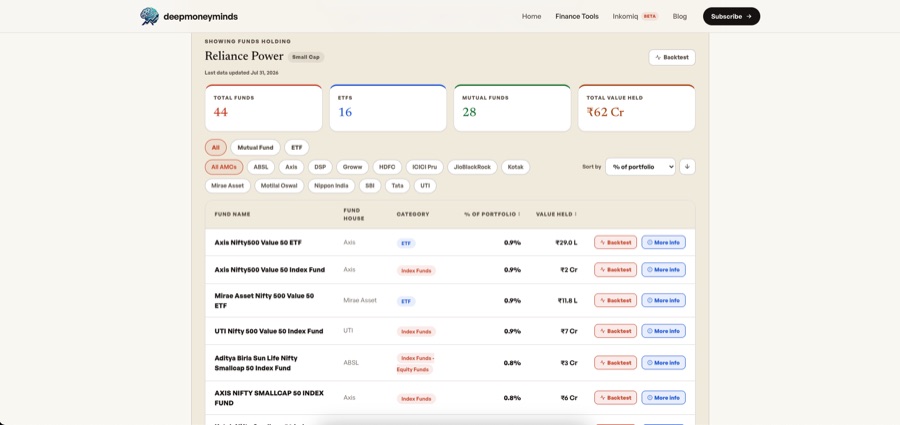
Yes. Fund Finder covers both regular mutual funds and exchange-traded funds (ETFs) across 16 major AMCs. ETF results are tagged with an ETF badge in the results, and you can filter to see only ETFs holding a stock — something most competitor tools do not offer in a single free view.
Can I compare exposure across fund houses?
Yes. Use the AMC filter chips to isolate funds from a single fund house, or sort by value held to see which AMC has the largest rupee exposure to that stock across all its schemes. You can also filter to ETFs only to compare passive exposure separately.
What is portfolio weight and why does it matter?
Portfolio weight (% of portfolio) tells you how much of a fund's total corpus is in one stock. A fund with 8% weight in a company has more single-stock concentration risk than a fund with 2% weight, even if both technically hold it. It's one of the clearest measures of how big any single bet really is inside a fund.
What does "value held" mean?
Value held is the rupee amount (shown in lakhs or crores) that a fund had invested in the stock at the time of its AMFI disclosure. It reveals absolute rupee exposure — useful for seeing which fund house has the largest money commitment to a stock, independent of each fund's total corpus size.
Does Fund Finder cover all AMCs operating in India?
Currently Fund Finder covers 16 AMCs: HDFC, ICICI Prudential, SBI, Nippon India, Axis, UTI, DSP, Mirae Asset, Kotak, Tata, Aditya Birla Sun Life, Groww, JioBlackRock, Motilal Oswal, PPFAS, and Quant. This includes newer fund houses not found on most competitor tools. More AMCs are being added.
Where does the holdings data come from?
All data comes from monthly portfolio disclosures that every AMC is required to file with AMFI under SEBI regulations. These disclosures list every security held by every scheme, with portfolio weight and market value. There is no modelling or estimation — only what AMCs officially reported to the regulator.
Is this tool free? Do I need to sign up?
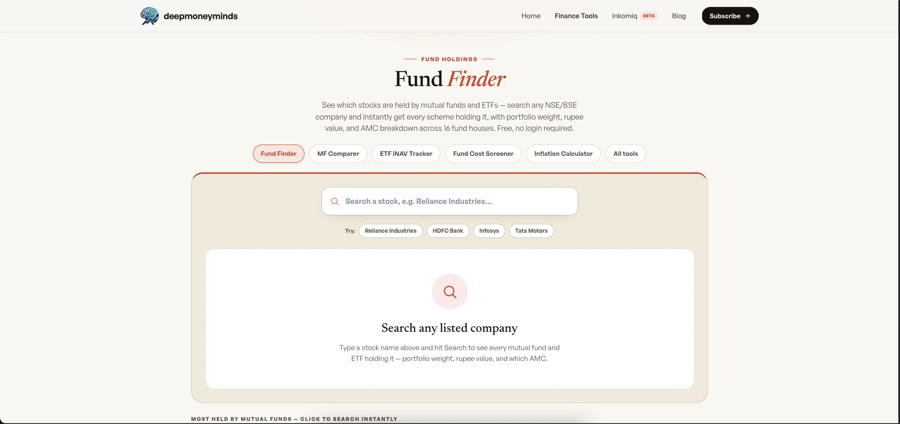
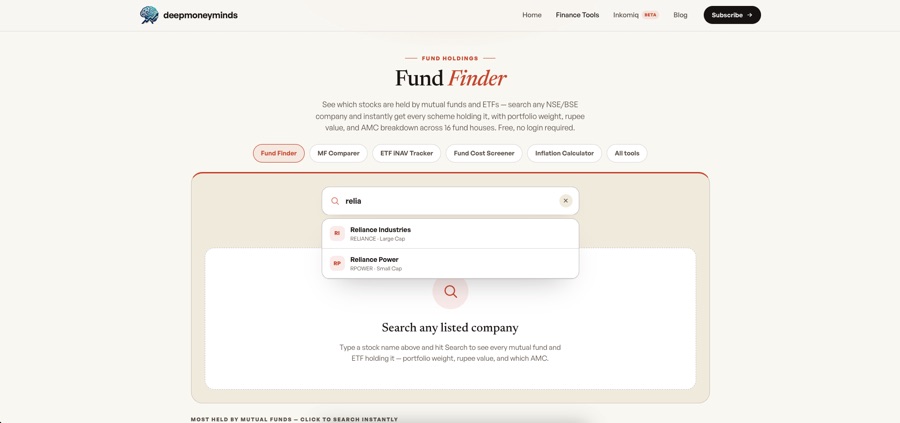
Completely free and no sign-up required. Open the page, type a stock name, and results appear instantly. There are no premium features and no email walls. Fund Finder is built by Deep Money Minds as a free resource for Indian retail investors.
Can I use this to check if my funds are over-concentrated in one stock?
Yes. Search a stock you're concerned about, then look for any of the funds you own in the results. If multiple funds you hold appear with significant portfolio weights in the same stock, you have hidden concentration risk — your "diversified" portfolio may not be as spread as it looks on paper.
Is this real-time data?
No. Portfolio disclosures are monthly, so holdings can change intraday while this table only updates once a new disclosure is filed by the AMC with AMFI. Think of it as a monthly snapshot — accurate as of the disclosure date shown next to results, not a live feed.
How is Fund Finder different from shareholding pattern tools?
Shareholding pattern tools (Trendlyne, Screener.in) show the aggregate stake held by all mutual funds combined in a stock, but not the breakdown by individual fund and AMC. Fund Finder shows every individual scheme — name, fund house, weight, and rupee value — in a single sortable table. It also includes ETFs in the same view, which most shareholding tools omit entirely.