Free MF Comparison Tool India ·
Mutual Fund Comparer
Compare mutual funds India side by side using real AMFI NAV data — completely free. Enter any two funds to see XIRR, SIP portfolio value, and drawdown on the same chart. Automatic start-date alignment ensures a fair comparison even when funds have different histories.
⚠️ Disclaimer: Educational use only. Past performance does not guarantee future results.
Pick Two Funds to Compare
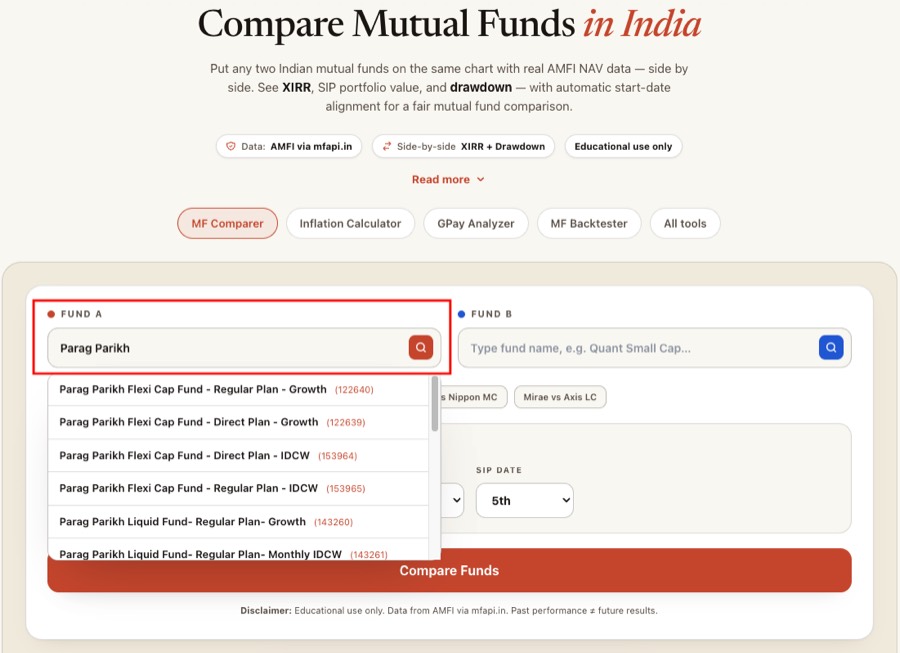
Search for Fund A and Fund B on the left, then hit Compare to see them plotted on the same chart with real historical data.
—
—
—
—
| Metric | Fund A | Fund B |
|---|
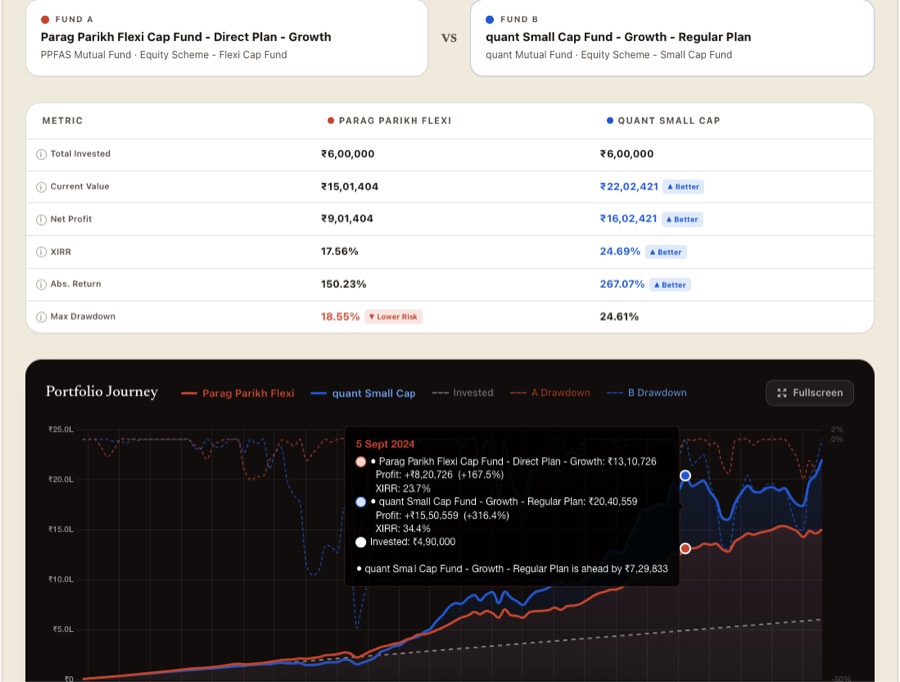
Portfolio Journey
Fund A Fund B Invested A Drawdown B DrawdownTap the chart to set a start point, tap again to analyse that range
Popular Fund Comparisons
Click any pair to pre-fill and compare instantly
Why Use This Mutual Fund Comparison Tool?
The problem with most fund comparison tools
Most platforms show funds on separate pages with different scales, making visual comparison nearly impossible. Worse, they rarely align start dates — if Fund A has 12 years of history and Fund B only 5, a naive comparison gives Fund A a structural advantage. Over 80% of retail investors don't check drawdown before investing, yet most tools don't show it. The result: investors pick the fund with the longer track record rather than the better risk-adjusted return for their actual investment window.
How this tool works — real AMFI NAV data, not estimates
NAV data is fetched in real-time from AMFI (Association of Mutual Funds in India) — the same official source used by Zerodha Coin, Kuvera, and other platforms. The tool simulates monthly SIP purchases at the actual published NAV on or nearest to your chosen SIP date, then calculates XIRR using real purchase prices. No projections, no assumed return rates — just what actually happened to your money. AMFI data is regulated by SEBI and updated daily.
Why XIRR + drawdown on the same chart changes everything
XIRR (Extended Internal Rate of Return) is the only metric that correctly accounts for the timing of every SIP installment — a fund with slightly lower XIRR but 40% less maximum drawdown may be far better for investors who can't stomach volatility. Most tools give you one without the other. This tool overlays both portfolio values and drawdown curves on the same chart so you see the complete picture — return AND risk — in a single view. Then use the range selection to tap any two points and isolate exactly how each fund behaved in that window.
How funds behaved differently during the 2020 COVID crash and 2022 correction
The Nifty 50 fell approximately 38% between January and March 2020, but recovery speeds varied sharply: Nifty 50 index funds recovered by August 2020, while small cap funds took until 2021. In the 2022 Fed-driven correction, mid and small cap funds fell 20–30% while defensive flexi cap funds fell 10–15%. Run a 5-year comparison on any fund pair and use the range selection to zoom into Jan–Mar 2020 or Jan–Jun 2022. The NAV data will show you exactly which fund held up — something no fund house's own marketing will tell you.
What you can compare — any AMFI fund, any pair, up to 15 years
Any fund registered with AMFI India works: flexi cap, small cap, mid cap, large cap, index funds, ELSS, debt, and hybrid. Durations: 1 to 15 years. Popular use cases: active vs passive showdown, same-category best-of comparison, comparing how expense ratio differences compound over 10 years via direct vs regular plan runs, or seeing whether a different SIP date would have meaningfully changed your outcome. If a fund exists in AMFI's registry, you can compare it here.
Approximate Historical Results
Click any tile above to run the real comparison with live AMFI data
10-Year SIP · ₹5,000/month
Flexi CapParag Parikh vs Quant Flexi Cap
PPFC approx. XIRR: 15–18% · Quant: 19–24%
Quant typically delivers higher XIRR in bull markets but with 30–40% deeper drawdowns during corrections. PPFC's international allocation provides a cushion in India-specific crashes.
5-Year SIP · ₹5,000/month
Index FundsUTI Nifty 50 vs Nifty Next 50
Nifty 50 approx. XIRR: 13–16% · Next 50: 14–18%
Nifty Next 50 has historically delivered slightly higher long-term returns with more short-term volatility. The 2022 correction hit Next 50 harder. For beginners: Nifty 50 is the lower-stress starting point.
7-Year SIP · ₹5,000/month
Small CapSBI Small Cap vs Quant Small Cap
SBI approx. XIRR: 18–22% · Quant: 22–28%
Both funds show strong long-term XIRR with maximum drawdowns of 35–45% in crash periods. SBI is more consistent across market cycles; Quant uses aggressive quantitative momentum.
10-Year SIP · ₹5,000/month
Large vs Mid CapMirae Asset Large Cap vs HDFC Mid Cap
Mirae approx. XIRR: 14–17% · HDFC Mid Cap: 17–21%
Mid cap delivered higher returns over 10 years with more volatility — classic risk-return tradeoff. Large cap is the defensive choice for investors closer to their goal.
⚠️ Approximate ranges based on historical NAV data. Past performance does not guarantee future results. Run the tool above for actual figures.
Frequently Asked Questions
What is a mutual fund comparison tool?
A mutual fund comparison tool lets you put two funds side by side to see how they would have performed under identical conditions — same SIP amount, same duration, same start date. This tool calculates XIRR (the most accurate return measure for SIPs), maximum drawdown, and net profit, and plots both portfolios on the same chart using real AMFI NAV data. Unlike generic calculators that use assumed returns, this shows what actually happened.
How do I compare two mutual funds side by side?
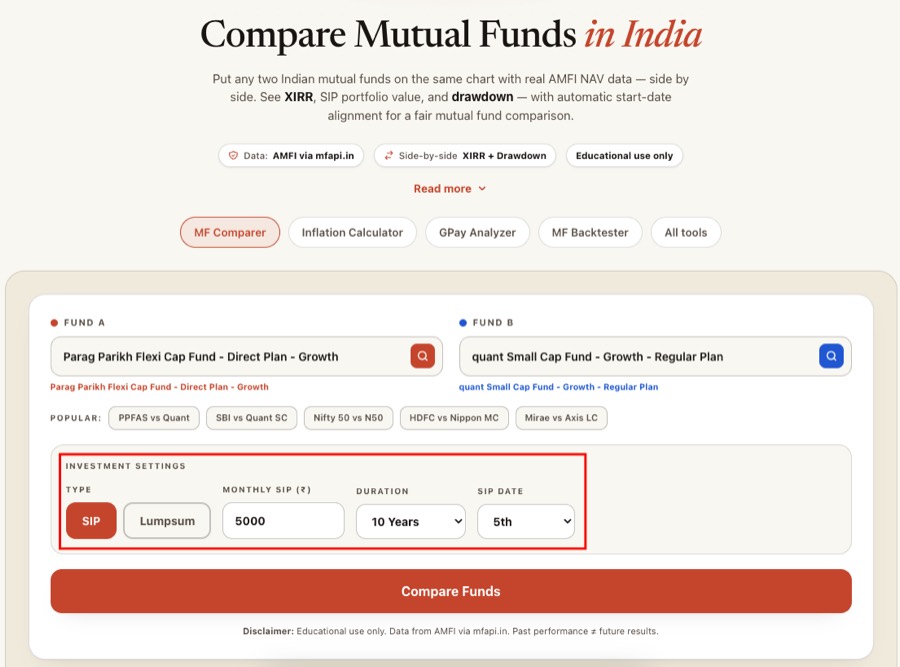
Type the first fund name in the Fund A search box (e.g. 'Parag Parikh Flexi Cap'), click Search, and select the fund. Repeat for Fund B. Enter your monthly SIP amount, choose a duration from 1 to 15 years, and pick a SIP date. Click Compare Funds — both funds are fetched from AMFI and plotted on the same chart within seconds. Or tap any Popular Comparisons tile above to pre-fill the form instantly.
Which mutual funds can I compare with this tool?
Any mutual fund registered with AMFI in India — flexi cap, small cap, mid cap, large cap, index funds, ELSS (tax-saving), debt funds, and hybrid funds. Simply type the fund name to search. Popular comparisons include Parag Parikh vs Quant Flexi Cap, SBI vs Quant Small Cap, UTI Nifty 50 vs Nifty Next 50, HDFC Mid Cap vs Nippon India Mid Cap, and Mirae Asset vs Axis Large Cap.
What is XIRR and how is it different from absolute returns?
XIRR (Extended Internal Rate of Return) is the true annualised return for investments made at different dates — exactly what a SIP is. Absolute return tells you the total percentage gain but ignores time, making comparison unfair. A 50% absolute return over 5 years is very different from 50% over 2 years. XIRR accounts for the timing of every installment and gives a fair annualised rate, so you can compare any two funds on a level playing field.
What is drawdown and why does it matter when comparing mutual funds?
Drawdown measures how far a fund's NAV has fallen from its most recent peak. If a fund peaked at ₹100 and dropped to ₹65, that's a -35% drawdown. This tool overlays the drawdown of both funds on the same chart so you can see which fund fell harder during market crashes. Maximum drawdown is a key risk metric — a fund with slightly higher XIRR but a -50% drawdown may cause investors to panic-sell at the worst possible time, destroying their actual returns.
How does the automatic start date alignment work, and why does it matter?
If Fund A started in 2015 and Fund B started in 2020, comparing all of Fund A's 10-year history against Fund B's 5-year history is unfair — Fund A captures 5 extra years of returns. This tool automatically detects the mismatch, trims both histories to start from the later date, and shows a yellow warning banner telling you exactly which fund was trimmed and from when. Every comparison is apples-to-apples — something most platforms like Groww or ET Money don't do.
How did Parag Parikh Flexi Cap compare to Quant Flexi Cap historically?
Parag Parikh Flexi Cap is known for defensive positioning and up to 35% international diversification, while Quant Flexi Cap uses an aggressive quantitative momentum model with higher concentration. Over 5–10 year SIP periods, Quant has often delivered higher XIRR in bull markets but with significantly deeper drawdowns during corrections. Use the Parag Parikh vs Quant quick-link tile above to run the actual comparison with real AMFI NAV data.
Does the SIP date — 1st, 5th, or 15th — affect the comparison?
For long-term SIPs of 5+ years, the difference in XIRR between SIP dates is typically less than 0.3–0.5% annually, because entry-point randomness averages out over hundreds of monthly purchases. For shorter periods of 1–2 years, the SIP date can matter more. Test different dates by changing the SIP Date dropdown and re-running to see the exact historical difference for your chosen fund pair.
What is the range selection feature and how do I use it?
After running a comparison, tap any point on the chart to mark a range start, then tap a second point to complete it. A panel appears showing: portfolio value at start and end, total change in rupees and percentage, NAV return for the selected window, and annualised NAV return. Ideal for comparing how each fund performed during the 2020 COVID crash (Jan–Mar 2020), the 2022 correction (Jan–Jun 2022), or any custom period you choose.
How is this different from Groww or ET Money's comparison tool?
Most platform comparison tools (Groww, ET Money, INDmoney) don't align start dates fairly, don't show drawdown, and don't calculate actual SIP XIRR. This tool does four things they don't: (1) auto-aligns both fund histories to the same start date, (2) overlays both portfolio values and drawdown on the same chart, (3) computes real SIP XIRR using actual AMFI NAV prices for every purchase, and (4) provides range-selection for period-specific analysis. All free, no signup needed.
Where does the NAV data come from?
Historical NAV data is fetched in real-time from AMFI (Association of Mutual Funds in India) via mfapi.in, which provides official daily NAV data for every AMFI-registered mutual fund. AMFI is the regulatory body for mutual funds in India operating under SEBI oversight. Data is fetched fresh on every comparison run, so you always see the most recently available prices.
Is this tool free? Do I need to sign up?
Yes, completely free. No signup, no account, no login required. Compare any two AMFI-registered mutual funds as many times as you want, with any SIP amount, any duration from 1 to 15 years, and any SIP date. There are no premium features or paywalls. The tool is built and maintained by Deep Money Minds, a free personal finance resource for Indian investors.
Can I compare index funds vs actively managed funds?
Yes. Any two AMFI-registered funds can be compared — including index funds vs active funds. A popular comparison is UTI Nifty 50 Index Fund vs an active large cap like Mirae Asset or Axis Large Cap. Over 10-year periods, many active large cap funds have struggled to consistently beat the Nifty 50 after expense ratios. Run a 10-year comparison to see the actual XIRR and drawdown difference — the data often tells a very different story from the fund house's marketing material.
What metrics should I look at when comparing two mutual funds?
Look beyond 1-year returns. The most important metrics are XIRR (for SIP investors — it accounts for the timing of each instalment), CAGR (for lumpsum), maximum drawdown (how much the fund fell during a crash), and expense ratio. For risk-adjusted quality, also check the Sharpe ratio. This tool shows XIRR and drawdown side by side on the same chart — which is the fairest way to compare two funds running SIPs.
What is XIRR and why is it better than CAGR for SIP comparison?
XIRR (Extended Internal Rate of Return) accounts for the exact dates and amounts of every SIP instalment, making it the accurate measure for systematic investments. CAGR assumes a single lumpsum and a single exit — it doesn't reflect how your money grew instalment-by-instalment. If you're comparing two funds via SIP, always look at XIRR, not point-to-point returns. Most tools bury this distinction; this one makes XIRR the primary metric.
What is drawdown in a mutual fund, and why does it matter?
Drawdown is the percentage fall of a fund's NAV from its highest peak to its lowest trough before recovering. A fund with a 40% drawdown fell 40% from its peak before it bounced back. Many funds look great on returns charts but have scary drawdowns during crashes (2020 COVID, 2022 rate hikes). Comparing drawdowns side by side tells you which fund is safer to hold without panic-selling — which is where most investors actually lose money.
Does a higher NAV mean a mutual fund is better or more expensive?
No — this is one of the most common misconceptions in India. A higher NAV simply means the fund has been around longer or has compounded more. Two funds with the same underlying portfolio but different NAVs (e.g. ₹800 vs ₹80) will give you identical percentage returns. You get more units from the lower-NAV fund, but each unit is worth less — the outcome is the same. Never pick a fund because of a low NAV; compare XIRR and drawdown instead.
Should I invest in two similar mutual funds — like two large-cap funds?
Generally not recommended. If two funds belong to the same category and hold similar stocks, you are not diversifying — you are just creating portfolio overlap and paying two expense ratios. Use this comparison tool to plot both funds on the same chart. If their NAV curves look nearly identical over 5 years, one of them is redundant. Overlap is especially common in large-cap and Nifty 50 index funds where holdings are almost identical across fund houses.
Is AMFI NAV data reliable? Where does this tool get its data from?
Yes — AMFI (Association of Mutual Funds in India) is the official industry body mandated by SEBI to publish daily NAVs. Every fund house reports NAV to AMFI by 11 PM each business day. This tool fetches data via mfapi.in, which is built directly on AMFI's official NAV feed — the same source used by Zerodha Coin, Groww, and other platforms. So the numbers are as accurate as it gets.
Can I compare a Direct plan mutual fund with a Regular plan fund?
Yes, and you should — especially if you're thinking of switching from Regular to Direct. Direct plans have lower expense ratios (typically 0.5–1% lower per year), so their NAV compounds faster. Plotting both on the same chart over 5–10 years visually shows exactly how much that annual cost difference compounds. Over 10 years on a ₹5,000/month SIP, the difference can be ₹2–4 lakhs or more, depending on the fund category.
How do I know which fund is better for a long-term SIP — by returns alone?
Returns alone are misleading. A fund with higher returns might have achieved them by taking more risk (high volatility, deep drawdown). Use three checks together: (1) XIRR — is the return meaningfully higher, or just marginal? (2) Drawdown — how badly did it crash in bad years? (3) Consistency — look at the chart across multiple market cycles, not just the last year. A fund with slightly lower XIRR but much lower drawdown may actually be better for a long-term SIP holder who won't panic-sell.
How many years of data should I compare to fairly judge a mutual fund?
At minimum 5 years — ideally 7–10 years, because this covers at least one full bull-bear market cycle. A fund that looks great on 1-year or 3-year data may have simply been lucky during a bull run. Use this tool's 10-year or 15-year mode to see how both funds held up through the COVID crash (2020), the 2022 rate-hike selloff, and multiple periods of sideways markets. Short-window comparisons are the biggest source of misleading fund selection decisions.
Kuldeep Singh
Personal Finance Writer & Developer
Kuldeep Singh builds free financial tools for Indian investors, covering mutual funds, ETFs, SIP investing, XIRR analysis, and portfolio planning at Deep Money Minds.