SWP in Mutual Funds: What ₹1 Crore Did Through the 2008 Crash
Same fund, same ₹1 crore, same start date: January 2008, just before the crash. We ran three monthly withdrawal amounts on real AMFI NAVs up to 20 Nov 2026. One still has ₹1.92 crore. Two hit zero.

 ▶ 6:51
Watch in Hindi: ₹1 crore, three withdrawal amounts, 18 years of real data (7 min)
Short answer
What is SWP in mutual fund?
SWP stands for Systematic Withdrawal Plan. You tell the fund to pay a fixed amount into your bank account every month (or quarter). To pay it, the fund sells some of your units at that day's NAV. The rest stays invested. The SWP ends when you stop it or when the units run out.
Sawaal yeh nahi hai ki fund kaun sa hai. Sawaal yeh hai ki aap kitna nikaal rahe ho.
That is the whole test in one line. Three people put ₹1 crore each into the same fund in January 2008. The only difference: how much each one took out every month.
The one who took ₹50,000 still has ₹1.92 crore. The one who took ₹1 lakh was at zero by April 2016.
HDFC Balanced Advantage Fund, Regular Growth (AMFI code 100119), ₹1 crore on 1 Jan 2008. NAVs up to 20 Nov 2026. One fund and one start date: past result, not a forecast.
How SWP works: your units are sold
An SWP doesn't pay interest. The money comes from your own units. Say you ask for ₹50,000 a month:
NAV ₹100
500 units sold
₹50,000 ÷ ₹100 = 500 units leave your account. You get ₹50,000.
Market falls · NAV ₹80
625 units sold
₹50,000 ÷ ₹80 = 625 units. You still get ₹50,000, but 125 more units are gone.
The catch — units sold in a crash are gone for good. When the market recovers, they aren't there to recover with it. So with SWP, two things matter most: how much you take out, and when the crash comes.
The test: ₹1 crore in January 2008
We picked the worst timing on purpose. The 2008 crash started within weeks, so any SWP that began in January 2008 had to survive it from day one.
Fund
HDFC Balanced Advantage
Called HDFC Prudence in 2008. It holds both shares and debt, which is why it often comes up for monthly income.
Plan
Regular, growth
Direct plans only started in January 2013, so 2008 data exists only for the regular plan.
Withdrawals
On the 1st
From February 2008, on the 1st of each month (next NAV day if a holiday), valued at the 20 Nov 2026 NAV.
Real AMFI NAVs via mfapi.in. No exit load, tax or stamp duty is deducted. The direct plan costs less every year; here's how much the gap adds up to.
₹50,000 vs ₹75,000 vs ₹1 lakh a month
Same fund, same crash, same start. Only the monthly amount is different.
| Monthly SWP | % of ₹1 cr a year | Total withdrawn | Result (20 Nov 2026) |
|---|---|---|---|
| ₹50,000 | 6% | ₹1.13 cr | ₹1.92 cr left |
| ₹75,000 | 9% | ₹1.33 cr | Zero on 3 Oct 2022after 14 yrs 9 mo |
| ₹1,00,000 | 12% | ₹98.4 L | Zero on 1 Apr 2016after 8 yrs 3 mo |
Even the ₹50,000 account fell to ₹36.9 lakh on 9 March 2009. Imagine being retired, with no salary, and opening a statement that shows ₹1 crore has become ₹37 lakh.
That is the hardest part of an SWP. The end result can look fine, but the road there is scary. The ₹50,000 account recovered because it sold fewer units in the crash. The bigger withdrawals sold more units at the lowest prices, and those units never came back.
Chart: value after the December withdrawal of each year; last point is 20 Nov 2026. Lowest point measured on daily NAVs. One fund, one start date: too few to trust as a rule. Past result, not a forecast.
SWP has no "interest rate"
₹1 lakh a month is ₹12 lakh a year, or 12% of ₹1 crore. Many people think: "the fund gives 12%, so I'll take out 12% and my money stays the same." In real data, that account was empty in 8 years.
An FD
Fixed interest
The bank promises a rate. Your capital doesn't move with the market.
An SWP
No fixed rate
Returns go up and down every year. Some years are minus. You get a fixed payout, but the units behind it keep changing.
Why 12% failed — no fund gives 12% every single year. The fund's long-run average doesn't help you if a crash hits while you're selling units every month. When people search for an "SWP interest rate" or "SWP return rate", the honest answer is: there isn't one.
With inflation: +6% a year
₹50,000 was a big amount in 2008. It isn't today. So what if the ₹50,000 person raised the withdrawal by 6% every year to keep up with prices?
Not bad: 18 years of rising income. But "the money will never run out" was wrong. With inflation, 6% of the starting amount ran out, while the flat ₹50,000 SWP still has ₹1.92 crore.
+6% applied every 12 withdrawals. Last withdrawal on 1 Dec 2025 was the remaining ₹61,163. Past result, not a forecast.
See what ₹50,000 will be worth later in the Inflation Calculator
Start date matters: April 2006 vs January 2008
Same plan: ₹50,000 a month, +6% every year, same fund. The only change: starting in April 2006 (the first month in our NAV data) instead of January 2008.
Started April 2006
₹4.06 crore still left
₹2.32 crore withdrawn so far. The monthly amount is now ₹1.60 lakh, and it's still running.
Started January 2008
Zero in December 2025
₹1.83 crore withdrawn. The crash came in the first year, when the most units were sold cheaply.
Why two years changed everything — the 2006 money grew for almost two years before the crash, so each withdrawal sold fewer units. The 2008 money fell straight away. This is called sequence of returns: the order in which good and bad years arrive. Nobody controls when the crash comes.
SWP from a Nifty 50 index fund?
Some people think: "do the SWP from an index fund, it gives more return." We ran the same three amounts from January 2008 on UTI Nifty 50 Index Fund (Regular, growth).
| Monthly SWP | HDFC Balanced Advantage | UTI Nifty 50 Index |
|---|---|---|
| ₹50,000 | ₹1.92 cr left | ₹76.2 L left |
| ₹75,000 | Zero, Oct 2022 | Zero, Dec 2018 |
| ₹1,00,000 | Zero, Apr 2016 | Zero, Nov 2014 |
At ₹1 lakh a month, the index fund didn't last 7 years. In this period, the fund that held only shares fell harder in the crash, so more units were sold at low prices.
UTI Nifty 50 Index Fund, Regular Growth (AMFI code 100822). Same method as above. Two funds and one start date: too few to trust as a rule, and a different period could give a different order. Past result, not a forecast.
₹1 crore from 2015 in 4 funds
The 2008 test used one fund in the worst possible year. Here is a calmer period. ₹1 crore went into each of 4 funds on 1 Jan 2015 (Direct plan, growth), with withdrawals from February 2015 to November 2026 (142 months). Balances are valued at the 20 Nov 2026 NAV.
| Monthly SWP | Parag Parikh Flexi CapParag Parikh | HDFC Balanced AdvantageHDFC BAF | SBI Large Cap | UTI Nifty 50 IndexUTI Nifty 50 |
|---|---|---|---|---|
| ₹33,3334% | ₹4.47 cr | ₹3.22 cr | ₹3.05 cr | ₹2.48 cr |
| ₹50,0006% | ₹3.77 cr | ₹2.62 cr | ₹2.52 cr | ₹1.98 cr |
| ₹83,33310% | ₹2.37 cr | ₹1.43 cr | ₹1.45 cr | ₹97.5 L |
| ₹83,33310% + 6% a year | ₹1.48 cr | ₹59.9 L | ₹68.6 L | ₹24.6 L |
Total withdrawn, the same in every fund: ₹47.3 L at 4%, ₹71.0 L at 6%, ₹1.18 cr at 10%, ₹1.66 cr at 10% + 6% a year.
Why none ran out: 2015–2026 was a good period for Indian shares, with no 2008-style crash in the first year. Even so, 10% raised 6% a year left the index fund with ₹24.6 lakh. In that row, all four balances were lower than a year earlier, and three of them (HDFC, SBI and UTI) were still falling at the last withdrawal. The same 10% that looks fine here is close to the 12% that emptied the account from 2008.
AMFI NAVs via mfapi.in (codes 122639, 118968, 119598, 120716). Direct plans, growth, no exit load or tax. These are four popular funds, not recommendations. The order would be different in another period: past results, not a forecast.
How much to withdraw: 4 rules of thumb
These are the rules from the video. They are general planning rules, not advice for your situation. First, what 4% and 6% a year mean in rupees:
| Corpus | 4% a year | 6% a year |
|---|---|---|
| ₹10 lakh | ₹3,333 / mo | ₹5,000 / mo |
| ₹50 lakh | ₹16,667 / mo | ₹25,000 / mo |
| ₹60 lakh | ₹20,000 / mo | ₹30,000 / mo |
| ₹1 crore | ₹33,333 / mo | ₹50,000 / mo |
Simple maths: corpus × rate ÷ 12.
Keep it near 6% or below
In our test, a flat 6% of the starting amount lasted through 2008; 9% and 12% didn't, and 6% raised every year ran out in 2025. ₹1 crore → ₹50,000 a month.
Keep 2–3 years of expenses aside
In an FD or a liquid fund. If a crash comes, pause the SWP and spend this money, so you don't sell units cheaply.
Skip the raise in a bad year
If the market fell, don't add the yearly inflation increase that year.
Watch how far the fund can fall
In this test, the fund holding shares and debt fell less than the pure index fund and lasted longer.
How SWP is taxed (vs FD interest)
Each SWP payout is a sale of units. Most of it is your own money coming back. Tax is due only on the profit part.
Example — your units cost ₹80 each and the NAV is now ₹100. Of every ₹100 you withdraw, ₹80 is your money back and only ₹20 is profit. On a ₹50,000 SWP, that is ₹10,000 of profit.
Equity-oriented fund
Tax on the profit only
Units held over 1 year: 12.5% on profit above ₹1.25 lakh in a financial year. Held under 1 year: 20%. (FY 2026-27 rules.)
Fixed deposit
Tax on all the interest
The full interest is added to your income and taxed at your slab rate, every year.
That's why, in the early years, tax on an SWP is usually much lower than on FD interest. Two checks before you start: the fund's exit load (often charged on units sold within the first year), and whether your fund is taxed as equity or debt. Debt fund units bought from 1 April 2023 are taxed at your slab rate.
Tax rules as per Budget 2026 (FY 2026-27). Rules change; check the latest before you start.
SIP vs SWP
They sound alike and work in opposite directions.
| SIP | SWP | |
|---|---|---|
| Money moves | Bank → fund | Fund → bank |
| Units | Bought every month | Sold every month |
| A crash | Buys more units cheaply | Sells more units cheaply |
| Used when | Building money | Spending from money |
For the building phase, see the SIP Calculator.
SWP vs IDCW vs FD
Three common ways to get a monthly income. Each pays you differently.
SWP
You fix the amount
The fund sells units to pay it. Tax only on the profit part.
IDCW
The fund decides
Payouts can be cut or skipped, and the full payout is taxed at your slab rate.
FD
The bank fixes the rate
Capital doesn't move with the market. All interest is taxed at your slab rate.
How a monthly IDCW was cut in a real fund: HDFC Balanced Advantage Fund review.
How to start an SWP
You can set it up on your fund house's website or app, through the registrar (CAMS or KFintech), on MF Central, or on the platform where you hold the fund.
Pick the folio and scheme
The units you already hold, or a new lump sum you invest first.
Choose the amount
Fixed rupees each time. Check what that is as a % of your corpus a year.
Set date and frequency
Monthly or quarterly, a start date, and an end date or number of payouts.
Check exit load and bank account
The money goes to your registered bank account. You can stop the SWP any time.
Who it's for, and who it isn't for
Usually used by
People living off a lump sum
Retired people, or anyone with a big amount who needs a salary-like payment every month. Many set one up for their parents.
Usually not for
People still earning
If you're still growing your money, that's a SIP's job. Taking money out early means fewer units left to grow.
Same fund. The amount decided how long it lasted.
From January 2008, through the worst crash in this data, 6% a year lasted and still has ₹1.92 crore. 9% ran out in 2022 and 12% in 2016. Raising it with inflation, starting two years earlier, or using a pure index fund changed the result a lot. One fund and one start date: past result, not a forecast.
Lasted in this test
- ✓₹50,000 a month (6%): ₹1.92 cr left
- ✓Same plan started April 2006, with +6% a year: ₹4.06 cr left
- ✓₹50,000 from the index fund: ₹76.2 L left
Ran out in this test
- •₹1 lakh a month (12%): zero in April 2016
- •₹75,000 a month (9%): zero in October 2022
- •₹50,000 + 6% a year from 2008: zero in December 2025
Frequently asked
How much can you withdraw from SWP?
+
Any amount you choose; the fund sells units to pay it. In our test from January 2008, ₹50,000 a month on ₹1 crore (6% a year) lasted and still has ₹1.92 crore. ₹75,000 (9%) ran out in October 2022 and ₹1 lakh (12%) in April 2016. One fund, one start date: past result, not a forecast.
How do you calculate the SWP amount?
+
Monthly SWP = corpus × yearly withdrawal rate ÷ 12. For example, ₹50 lakh × 5% ÷ 12 = ₹20,833 a month. To see how a rate held up in a real fund, run it in the MF Backtester.
Can I do an SWP for 1 year?
+
Yes. You set the start date and an end date or the number of payouts, and you can stop it any time. Units sold within the exit-load period may be charged an exit load, and profit on equity units held under one year is taxed as short-term gains.
How is SWP different from SIP?
+
A SIP moves money from your bank into a fund and buys units every month. An SWP moves money from the fund to your bank and sells units every month. A SIP is used to build money; an SWP to spend from it.
Which SWP plan is best?
+
There's no single answer, and we don't recommend funds. In our test, the withdrawal amount mattered more than anything else: in the same fund, from the same date, ₹50,000 a month still has ₹1.92 crore while ₹1 lakh a month hit zero in 8 years.
What is the 4% SWP rule?
+
Take out 4% of your starting corpus in the first year, then raise it with inflation. It comes from US retirement studies of the 1990s. On ₹1 crore, 4% is ₹33,333 a month. In our test fund from January 2008, ₹33,333 raised 6% a year still had ₹2.11 crore left after ₹1.33 crore withdrawn (past result, not a forecast).
How much SWP for 10 lakh?
+
At 4% a year, ₹3,333 a month. At 6% a year, ₹5,000 a month. A higher amount means selling more units every month, and in our test 9% and 12% a year ran out.
How much SWP for 60 lakhs?
+
At 4% a year, ₹20,000 a month. At 6% a year, ₹30,000 a month.
Which SWP is best for 5 years?
+
For a short period, how far the fund can fall matters most, because a crash has little time to recover before you need the money. That's why short-term needs are often kept in less volatile options such as FDs or debt funds. Check the fund's past falls and exit load before you start.
What is the SWP interest rate?
+
There isn't one. An SWP pays a fixed amount by selling units, and the fund's return changes every year, including minus years. That's why taking out 12% a year, close to the fund's long-run average, still ran out in 8 years in our test.
Is SWP taxable?
+
Only the profit part of each payout is taxed; the rest is your own money coming back. For equity-oriented funds held over one year, profit above ₹1.25 lakh in a financial year is taxed at 12.5%; held under one year, 20% (FY 2026-27 rules). FD interest, by contrast, is fully taxed at your slab rate.
Sources
- AMFI: daily NAVs of mutual fund schemes
- mfapi.in: historical NAV data (from AMFI), codes 100119 and 100822
- Business Standard: Budget 2026 keeps LTCG rates unchanged for FY27
- ICICI Prudential AMC: Tax Reckoner 2026-27 (PDF)
This is a data explainer, not investment advice. We are not SEBI-registered. Past returns do not guarantee future returns. Mutual fund investments are subject to market risks; read all scheme-related documents carefully. Speak to a SEBI-registered adviser before choosing a fund or an amount.
 Fund Review
HDFC Balanced Advantage Fund review
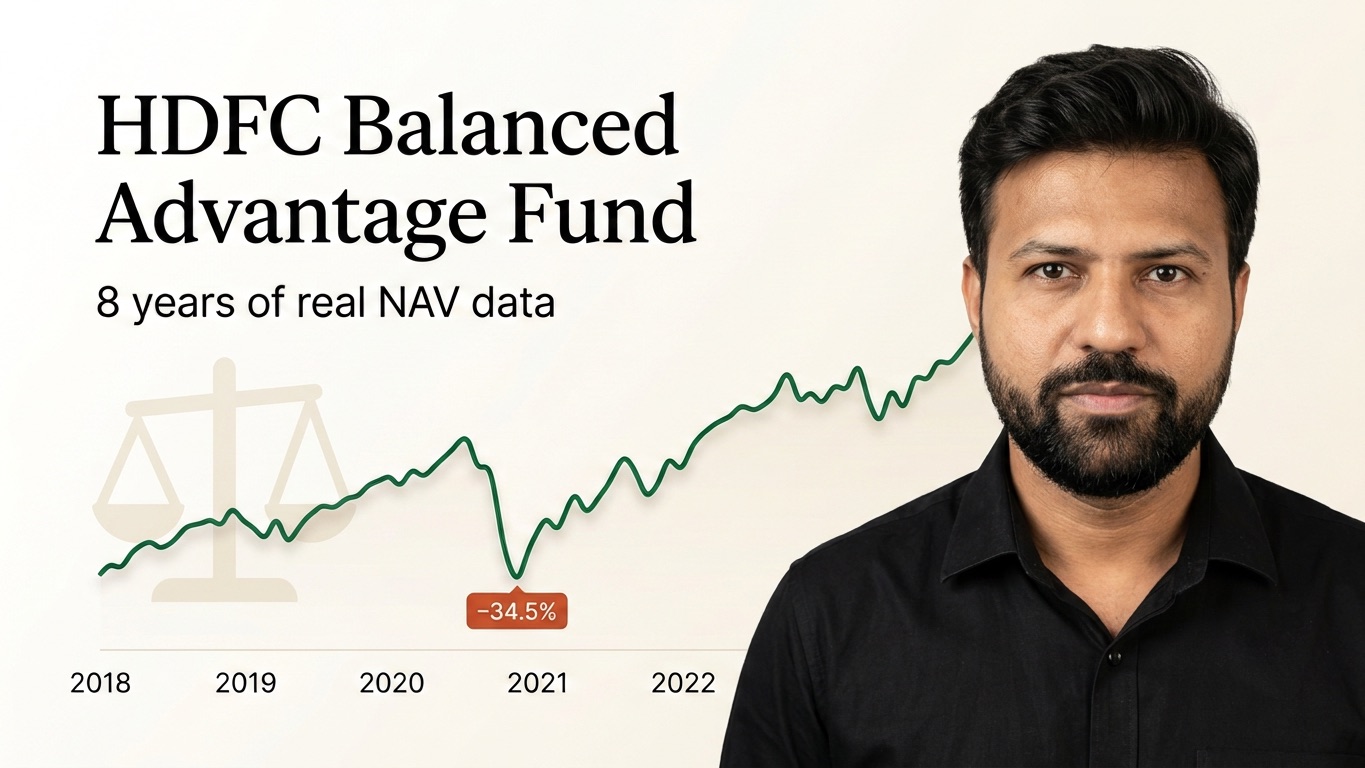
₹5,000 SIP since 2018 returned 13.48% a year, but the fund fell 34.5% in 2020 and the monthly IDCW was cut.
 MF Basics
Direct vs Regular Mutual Fund: real cost
Over 10 years, regular plans of 6 popular funds returned 0.77–1.11% less a year.