What is a goal-based SIP calculator?
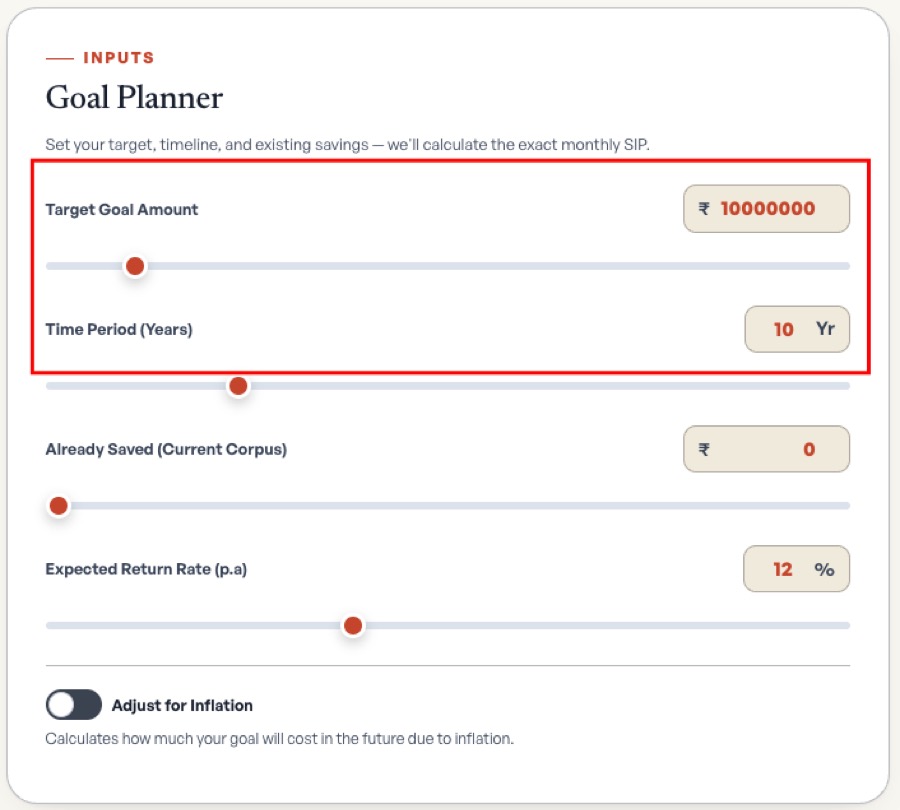
A goal-based SIP calculator works in reverse. Instead of telling you how much your SIP will grow to, it takes your target amount (e.g., ₹50 lakhs for a home, ₹25 lakhs for a wedding), the number of years you have, and your expected annual return — and calculates exactly how much you need to invest every month to reach that goal. It gives your money a direction, not just a number.
What is the difference between a regular SIP calculator and a goal-based SIP calculator?
A regular SIP calculator starts with the monthly amount you invest and shows what it will grow into. A goal-based SIP calculator flips this: you tell it your target corpus and timeline, and it tells you what SIP amount you need today. Think of a regular calculator as forward-looking and a goal SIP calculator as a reverse solver — it works backward from your goal to tell you exactly what to invest now.
How accurate is the goal-based SIP calculator?
The calculator gives a mathematically precise estimate based on your inputs — goal amount, time horizon, and expected return rate. However, since mutual fund returns are market-linked and not guaranteed, the output is a planning estimate, not a promise. The closer your actual returns are to your assumed rate, the more accurate the result. Use it as a planning floor, not a ceiling.
What expected return rate should I use in the goal SIP calculator?
As a thumb rule used by most Indian financial planners: use 10–11% for large-cap equity mutual funds, 11–13% for flexi-cap or diversified funds, and 6–7% for debt funds. For a conservative goal plan, assume 10%; for an aggressive one, 12%. Avoid assuming above 14% — it makes the plan look easy but creates a dangerous gap between expectation and reality when markets don't cooperate.
Can I include an existing lump sum along with my monthly SIP in the goal calculator?
Yes — and this is one of the most important inputs many calculators miss. If you already have ₹2 lakhs saved toward your goal, that lump sum will compound on its own over your investment period. Our goal planner lets you enter your existing corpus alongside your monthly SIP, giving you a much more realistic picture of how much additional SIP you actually need — rather than planning as if you're starting from zero.
How do I set a realistic goal amount in the calculator?
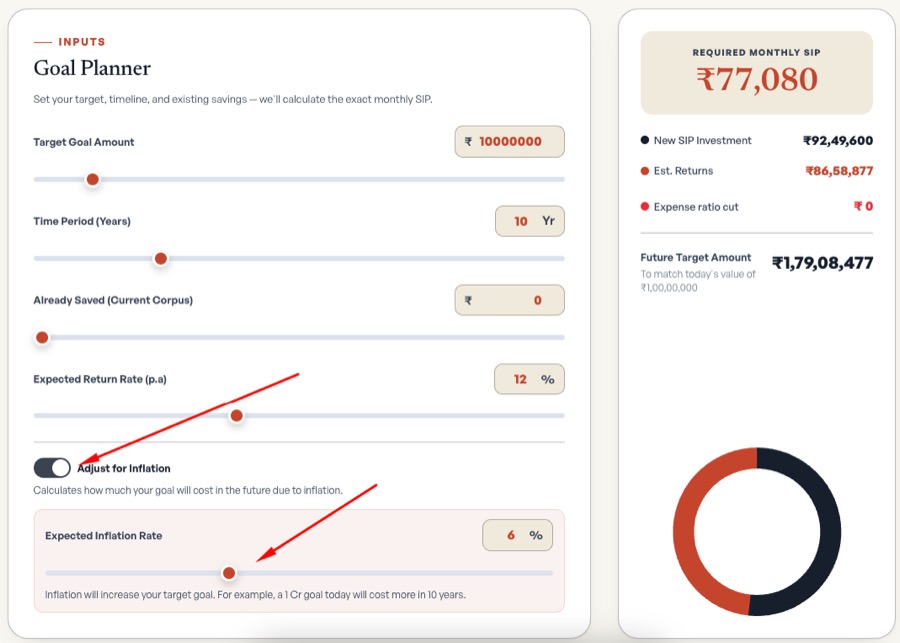
Start with today's cost of your goal, then factor in inflation. For example, if a college education costs ₹15 lakhs today and your child is 8 years away from needing it, at 6% education inflation it will cost roughly ₹25 lakhs. Always enter the future, inflation-adjusted value — not today's price — or use the inflation toggle in our calculator to compute it automatically.
What is the 15-15-15 rule in SIP, and does it work?
The 15-15-15 rule says: invest ₹15,000 per month in a mutual fund targeting 15% annual returns for 15 years — and you could accumulate approximately ₹1 crore. It is a popular mental shortcut for first-time investors. However, consistently achieving 15% returns is ambitious; most long-term equity funds average 11–13% CAGR over 15 years. Use our goal planner to stress-test your specific target with conservative (10%), moderate (12%), and aggressive (14%) return assumptions.
What is the 7-5-3-1 rule in SIP?
The 7-5-3-1 rule is a behavioural investing framework: stay invested for at least 7 years, spread your SIP across 5 asset classes for diversification, prepare for 3 emotional phases (excitement, doubt, recovery) during market cycles, and increase your SIP by at least 1 step-up per year as your income grows. It is not a mathematical formula — it is a discipline guide that pairs perfectly with a goal-based SIP plan to ensure you stay on track through market volatility.
What is a Step-Up SIP, and how does it help me reach my goal faster?
A Step-Up SIP (also called a Top-Up SIP) lets you automatically increase your monthly SIP amount by a fixed percentage every year — typically 10%. Since your income usually rises annually, this keeps your investment growing proportionally. The impact is significant: a ₹10,000 SIP stepped up by 10% every year generates nearly 40% more corpus over 15 years compared to a flat ₹10,000 SIP at the same return rate. Start with a lower SIP today and plan to step it up as your salary grows.
How much SIP do I need to reach ₹1 crore in India?
It depends on your timeline and assumed return rate. At 12% annual returns: a 10-year goal needs approximately ₹43,000/month, a 15-year goal needs approximately ₹19,800/month, and a 20-year goal needs only approximately ₹10,000/month. The message is clear: start earlier, invest less. Enter ₹1 crore as your target in the calculator above and adjust the timeline slider to see exactly how dramatically the required monthly SIP drops with every additional year you give yourself.
Can I use this goal planner for multiple goals like education, wedding, and retirement together?
Yes. Each life goal should ideally have its own dedicated SIP — a separate "bucket" with a specific target amount, timeline, and fund type. Short-term goals (1–3 years) like a wedding suit debt funds. Medium-term goals (3–7 years) like a home down payment suit hybrid funds. Long-term goals (7+ years) like retirement or child education suit equity funds. Use this goal planner to model each goal individually and add up the required monthly SIPs to see your total commitment.
What happens if I stop my SIP before reaching my goal?
Your existing mutual fund units stay invested and continue to grow with market movements — stopping future installments does not cancel your past investments. However, your goal will have a funding gap. The smart move: pause the SIP (most AMCs allow a 1–3 month pause) rather than cancel it, then restart. If you must stop, recalculate a new SIP amount for the remaining period using this calculator with your current balance as the "Already Saved" corpus field.
How does inflation affect my goal amount, and should I account for it?
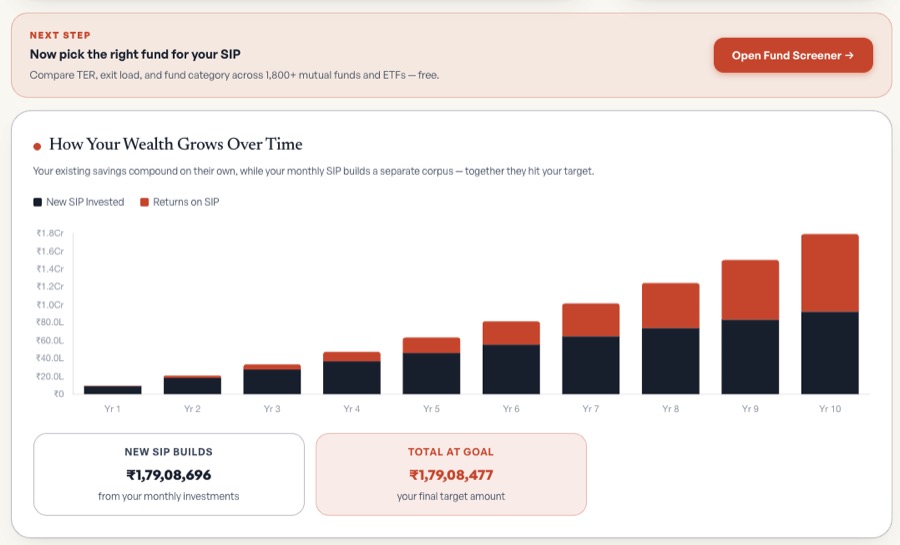
Inflation affects your goal in two ways. First, it increases the future cost of your goal — ₹10 lakhs today for education may cost ₹18 lakhs in 10 years at 6% inflation. Second, it erodes the real purchasing power of your returns. Most people only worry about returns and forget to inflate their target. Always enter your inflation-adjusted goal amount, or use the inflation toggle in our calculator to automatically compute how much your goal will cost in the future.
⚠️ Disclaimer: This calculator is for educational and planning purposes only. Results are estimates based on your inputs. Mutual fund returns are market-linked and not guaranteed. Past performance does not indicate future results. Consult a SEBI-registered investment advisor before making investment decisions.